
Ranked: Reactor Material, Agitator and Seal Combinations for Corrosive and High-Shear Service
The right reactor package for corrosive and high-shear duty is not a single material or a single agitator. It is a combined decision across wetted material, agitator type, seal type, heating and cooling method, and the standards pathway. In this application-fit ranking, the top package is a Hastelloy reactor with a high-shear agitator, magnetic seal and external coil or jacket cooling for severe corrosive duty. The ranking then moves to titanium, SS316L and SS304 packages as corrosion load and shear demand decrease. The ranking is built from the custom reactor options listed by Jiangsu Xuyang Chemical Equipment Co., Ltd. and is not a laboratory performance ranking or a claim that one material is universally superior.
Problem Definition: Why Material, Agitator and Seal Must Be Selected Together
Corrosive service defines the wetted material. High-shear service defines the agitator, shaft, drive and seal loads. In practice, these choices interact. A high-shear impeller can improve mixing and dispersion, but it also adds mechanical energy and heat that must be removed by the jacket or external coil. A magnetic seal can support containment priorities, while a mechanical seal may be preferred where service access and general chemical duty are the main concerns. If the material, agitator, seal and heat-transfer method are selected separately, the reactor may satisfy one requirement while creating a weakness in another.
The available custom reactor parameters list SS304, SS316L, carbon steel, Hastelloy, titanium and zirconium as material options; anchor, paddle, turbine, ribbon and high-shear as agitator options; mechanical and magnetic seals; steam, thermal oil or electric heating; cooling water or chilled water; and jacket or external coil heat transfer. The same product parameter list states that working pressure and working temperature are customized according to process requirements. That is why a ranked shortlist must be read as a starting point for technical discussion, not as a catalogue of fixed models.
For buyers, the practical problem is to match the package to the duty without over-specifying one component and under-specifying another. A Hastelloy shell may be justified by the medium, but the seal and agitator still need to handle the shaft load and containment requirement. An SS304 shell may be adequate for routine chemical service, but it should not be asked to carry a severe corrosive duty merely because the agitator and seal are robust.
Industry Background: Standards, Corrosion and Heat Removal Are Linked
Pressure-vessel standards shape the commercial pathway as much as the technical one. ASME BPVC Section VIII is an engineering framework for the design, analysis, fabrication, inspection and testing of pressure vessels, including reactors, heat exchangers, filters and specialty vessels. In export projects, buyers may also require GB, EN or PED. The reactor parameter list from Jiangsu Xuyang includes ASME, GB, EN and PED as design standard options, and ASME U Stamp, CE and ISO as certification options.
Compliance also affects budget. A market estimate cited by Fortune Business Insights suggests that ASME compliance can represent up to 20% of a pressure vessel's total material cost. That figure is a planning signal, not a quotation. The actual cost depends on design pressure, design temperature, material, inspection scope, certification scope and documentation requirements. For corrosive and high-shear service, the cost discussion should therefore be tied to the selected package, not to a generic reactor category.
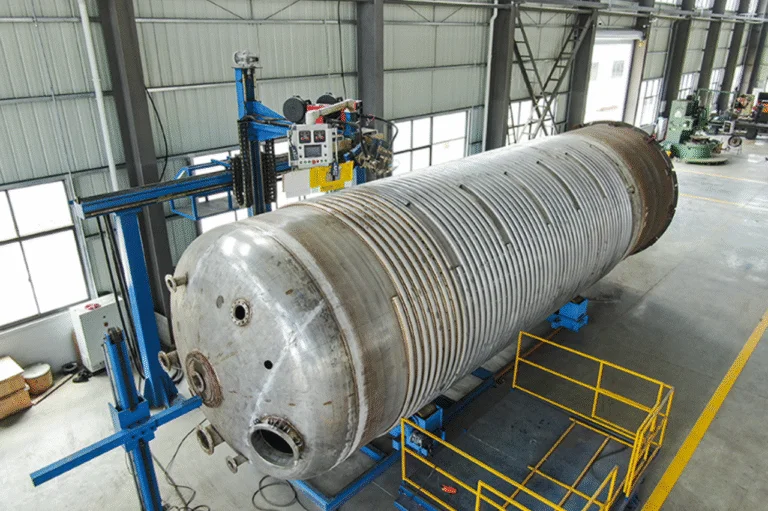
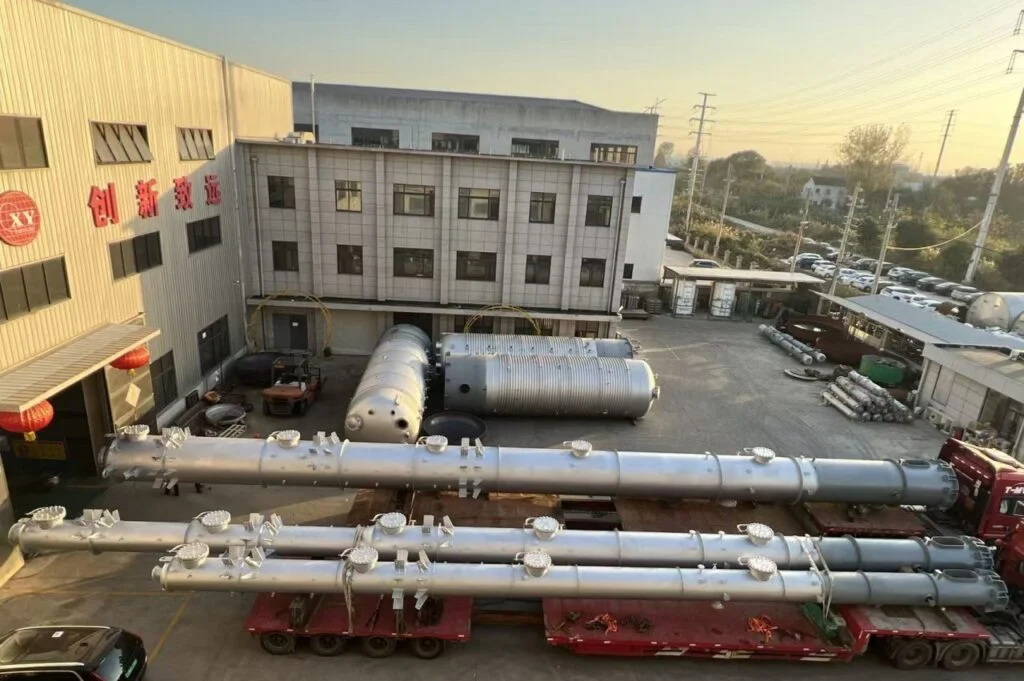
Heat removal is the third part of the background. High-shear agitation adds mechanical energy, and the resulting heat must be managed by the selected heating and cooling method. The available options include steam, thermal oil and electric heating, plus cooling water or chilled water, with jacket or external coil heat-transfer surfaces. The company also lists a 5000 L horizontal external half-pipe coil reactor in its product listings, which confirms that external coil construction is part of the available reactor scope.
Detailed Solution: Ranked Reactor Configuration Packages
The ranking below orders configuration packages by fit for corrosive and high-shear service. Rank 1 is the most conservative package for severe corrosive duty with containment priority. Lower ranks are not inferior in every application; they are lower because they fit narrower corrosion or shear conditions. The correct rank for a project depends on medium composition and concentration, operating and design temperature, operating and design pressure or vacuum, required capacity, corrosion-resistance requirement and site utilities.
Rank 1 - Hastelloy reactor + high-shear agitator + magnetic seal + external coil or jacket
This package is ranked first for severe corrosive and high-shear service because it combines the most corrosion-resistant material option in the focus list with the most direct high-shear agitator option and a containment-oriented seal choice. Hastelloy is listed as a special-material reactor option where required. The high-shear agitator is the direct choice when shear is the controlling unit operation. The magnetic seal is selected when leakage containment is the priority. Heating can be steam, thermal oil or electric, and cooling can use cooling water or chilled water through a jacket or external coil.
The boundary is equally important. Hastelloy is a material family, not a single grade, and the final alloy selection must be confirmed against the actual medium. The magnetic seal must be checked against torque, speed, temperature and pressure. The external coil or jacket must be sized for the heat load created by the high-shear agitator. This package is therefore a strong starting point, not a substitute for a technical agreement.
Rank 2 - Titanium reactor vessel + turbine agitator + mechanical seal + jacket
Titanium is ranked second because it is listed as a reactor material for corrosive duty and is often considered where the medium and operating conditions make titanium suitable. The turbine agitator is paired here because it provides circulation and shear in lower-viscosity liquids. The mechanical seal is the general sealing option for this package, and the jacket provides wall heating or cooling. Steam, thermal oil or electric heating can be combined with cooling water or chilled water.
This package is ranked below Hastelloy because titanium suitability is medium-dependent. It should not be selected merely because it is a corrosion-resistant metal. The buyer should confirm the medium, concentration, temperature, pressure and any project-specific standard requirement. The turbine agitator is also not a universal high-shear substitute; it is placed second because it can support high circulation and shear in appropriate low-viscosity duty, while a dedicated high-shear head remains the first choice when dispersion or intense local shear is the main process requirement.
Rank 3 - SS316L reactor + high-shear agitator + mechanical seal + jacket or external coil
SS316L is ranked third because it is a stainless steel reactor option positioned for more demanding routine chemical service than SS304, while remaining below Hastelloy and titanium for severe corrosive duty. High-shear agitation and a mechanical seal make this a practical package for moderate corrosive duty where shear is important but containment does not require a magnetic seal. Heating can be steam, thermal oil or electric; cooling can be cooling water or chilled water; heat transfer can be by jacket or external coil.
The limitation is the corrosion boundary. SS316L is not a universal answer for every corrosive medium. The material selection process should confirm medium composition and concentration, operating temperature, design temperature, operating pressure, design pressure or vacuum, required capacity and corrosion-resistance requirement before the material is fixed. If those inputs point to a more aggressive duty, the package should move toward Rank 1 or Rank 2 rather than relying on agitation and seal quality alone.
Rank 4 - SS304 reactor + paddle or anchor agitator + mechanical seal + jacket
SS304 is ranked fourth because it is suited to routine chemical service rather than severe corrosive duty. The paddle or anchor agitator is paired with a mechanical seal for gentle bulk movement, close-clearance wall heat transfer or higher-viscosity duty where intense shear is not the primary requirement. Steam, thermal oil or electric heating can be used with cooling water or chilled water, and the jacket provides the heat-transfer surface.
This package should not be selected for high-shear dispersion. Paddle and anchor agitators are low-shear devices, and their position in this ranking reflects that boundary. They are included because not every corrosive-service reactor is a high-shear reactor; some projects need reliable routine chemical service, wall heat transfer and simple mechanical sealing more than they need a high-shear head.
Rank 5 - SS304 or SS316L reactor + ribbon agitator + mechanical seal + jacket
The ribbon package is ranked fifth for this specific topic because it is not a high-shear solution. It is included for transition duty where higher-viscosity blending and uniform heat transfer dominate, and where the process can accept lower shear. SS304 or SS316L can be used depending on the corrosion load. The mechanical seal is the general sealing option, and the jacket supports heating or cooling.
This package is a reminder that the ranking is not a universal league table. A ribbon agitator can be the right choice for a viscous duty, but it should not be specified for high-shear dispersion. The same logic applies to anchor and paddle agitators. The buyer should first define the unit operation, then select the agitator, then confirm the material and seal.
Comparison Table: Ranked Reactor Packages
| Rank | Package focus | Reactor material | Agitator | Seal | Heating / cooling | Boundary |
|---|---|---|---|---|---|---|
| 1 | Severe corrosive duty + high shear + containment priority | Hastelloy | High-shear | Magnetic | Steam, thermal oil or electric heating; cooling water or chilled water; jacket or external coil | Confirm alloy grade, torque, speed, temperature, pressure and code scope |
| 2 | Corrosive duty where titanium is suitable + high shear | Titanium | Turbine | Mechanical | Steam, thermal oil or electric heating; cooling water or chilled water; jacket | Confirm medium compatibility and project standard |
| 3 | Moderate corrosive duty + high shear | SS316L | High-shear | Mechanical | Steam, thermal oil or electric heating; cooling water or chilled water; jacket or external coil | Confirm corrosion load and capacity |
| 4 | Routine chemical service + low-to-medium shear | SS304 | Paddle or anchor | Mechanical | Steam, thermal oil or electric heating; cooling water or chilled water; jacket | Not for severe corrosive duty or high-shear dispersion |
| 5 | Viscous transition duty + lower shear | SS304 or SS316L | Ribbon | Mechanical | Steam, thermal oil or electric heating; cooling water or chilled water; jacket | Not a high-shear substitute |
Agitator and Seal Ranking for High-Shear Duty
Agitator ranking must be separated from material ranking. A corrosion-resistant shell does not make a low-shear agitator suitable for high-shear service, and a high-shear agitator does not correct an unsuitable wetted material. The table below ranks the five listed agitator types for high-shear duty and pairs each with the seal options that should be discussed with the supplier.
| Rank for high-shear duty | Agitator | Seal pairing to discuss | Position logic | Boundary |
|---|---|---|---|---|
| 1 | High-shear | Magnetic for containment priority; mechanical for general service access | Direct high-shear choice when shear or dispersion is the controlling unit operation | Confirm torque, speed, temperature and process compatibility |
| 2 | Turbine | Mechanical or magnetic | High circulation and shear in lower-viscosity liquids | Not a universal substitute for a dedicated high-shear head |
| 3 | Ribbon | Mechanical | Uniform blending in higher-viscosity duty; lower shear than high-shear or turbine | Do not select for high-shear dispersion |
| 4 | Paddle | Mechanical | Gentle bulk movement and low shear | Not for high-shear duty |
| 5 | Anchor | Mechanical | Close-clearance wall heat transfer and high-viscosity movement; low shear | Not for high-shear duty |
The seal decision should be made with the agitator, not after it. Mechanical seals and magnetic seals are both listed options. Magnetic seals are selected when containment is the priority. Mechanical seals are the general option when service access and standard chemical duty are the main concerns. The final choice depends on the process conditions and must be confirmed in the technical agreement.
Heating and Cooling: How Jacket, External Coil and Utility Choice Change the Recommendation
Heating and cooling can move a package up or down the shortlist because high-shear agitation creates heat that must be removed. The available reactor options include steam, thermal oil or electric heating, and cooling water or chilled water. Heat-transfer surfaces can be a jacket or an external coil. The external coil reactor is a listed product type, and the company also lists a 5000 L horizontal external half-pipe coil reactor. That matters when the jacket area is insufficient for the heat load or when the project layout favors an external coil.
For a first review, the utility logic is straightforward. Steam and thermal oil require a heating utility and a heat-transfer surface. Electric heating provides a direct electric heating option. Cooling water or chilled water provides the cooling medium. A jacket gives wall heat transfer around the vessel. An external coil adds an external heat-transfer surface. The recommendation changes when the high-shear duty requires more heat removal than the jacket can provide, when the site lacks a suitable heating utility, or when the required cooling water temperature is not available and chilled water must be considered.
Heat-transfer capability should also be checked against adjacent equipment. In one Kazakhstan importer case, Jiangsu Xuyang supplied one shell and tube heat exchanger for process heat exchange; the project has operated for 10 years with stable operation and cost-effective results. That case is for a heat exchanger, not a reactor, but it shows the heat-transfer discipline that supports reactor heating and cooling packages. The reactor quotation should still confirm the heat duty, utility conditions and surface area for the specific project.
Step-by-Step Breakdown: How to Specify the Package
- Define the duty and unit operation. Confirm whether the reactor is for reaction, mixing, dispersion, concentration, crystallization or another process. State whether high shear is the primary requirement or a secondary effect.
- Confirm the medium and corrosion load. Record medium composition and concentration, operating temperature, design temperature, operating pressure, design pressure or vacuum, required capacity and corrosion-resistance requirement. The material selection process in the company FAQ follows this sequence before finalizing the material.
- Select the wetted material. Use SS304 or SS316L for routine chemical service, and move to Hastelloy or titanium where the corrosion duty requires it. Confirm the final grade and any project-specific standard requirement.
- Select the agitator. Use high-shear first for high-shear duty, turbine for lower-viscosity circulation and shear, ribbon for higher-viscosity transition duty, and paddle or anchor for low-shear bulk movement or close-clearance heat transfer.
- Pair the seal with the agitator. Discuss mechanical and magnetic seals together with shaft load, speed, temperature, pressure and containment priority. Do not treat the seal as a late add-on.
- Select heating and cooling. Choose steam, thermal oil or electric heating, and cooling water or chilled water. Decide whether the jacket or external coil provides the required heat-transfer surface.
- Confirm standards, certification and scale. Lock the design standard from ASME, GB, EN or PED, then confirm the certification scope, including ASME U Stamp, CE and ISO where applicable. Confirm volume from laboratory to industrial scale, MOQ and lead time.
Use Cases: Where Each Package Fits
- Severe corrosive duty with high shear: Hastelloy reactor, high-shear agitator, magnetic seal and external coil or jacket cooling. This is the first package to review when containment and corrosion resistance dominate.
- Corrosive duty where titanium is suitable: Titanium reactor vessel, turbine agitator and mechanical seal with jacket. Confirm medium compatibility before selecting titanium.
- Moderate corrosive duty with high shear: SS316L reactor, high-shear agitator and mechanical seal with jacket or external coil. This is a practical middle path when the corrosion load does not justify Hastelloy or titanium.
- Routine chemical service with low-to-medium shear: SS304 reactor with paddle or anchor agitator and mechanical seal. Use this where the duty is routine and intense shear is not required.
- Viscous transition duty: SS304 or SS316L reactor with ribbon agitator and mechanical seal. Use this where higher-viscosity blending and uniform heat transfer dominate, not where high shear is the main requirement.
The reactor parameter list covers chemical, fine chemical, petrochemical, pharmaceutical, biochemical, new energy, battery materials, agrochemical, dyes and pigments, polymer and resin, coatings, oil and gas, food and beverage, and environmental protection applications. That breadth is why the package should be selected by duty, not by a single industry label.
Manufacturing and Compliance Proof
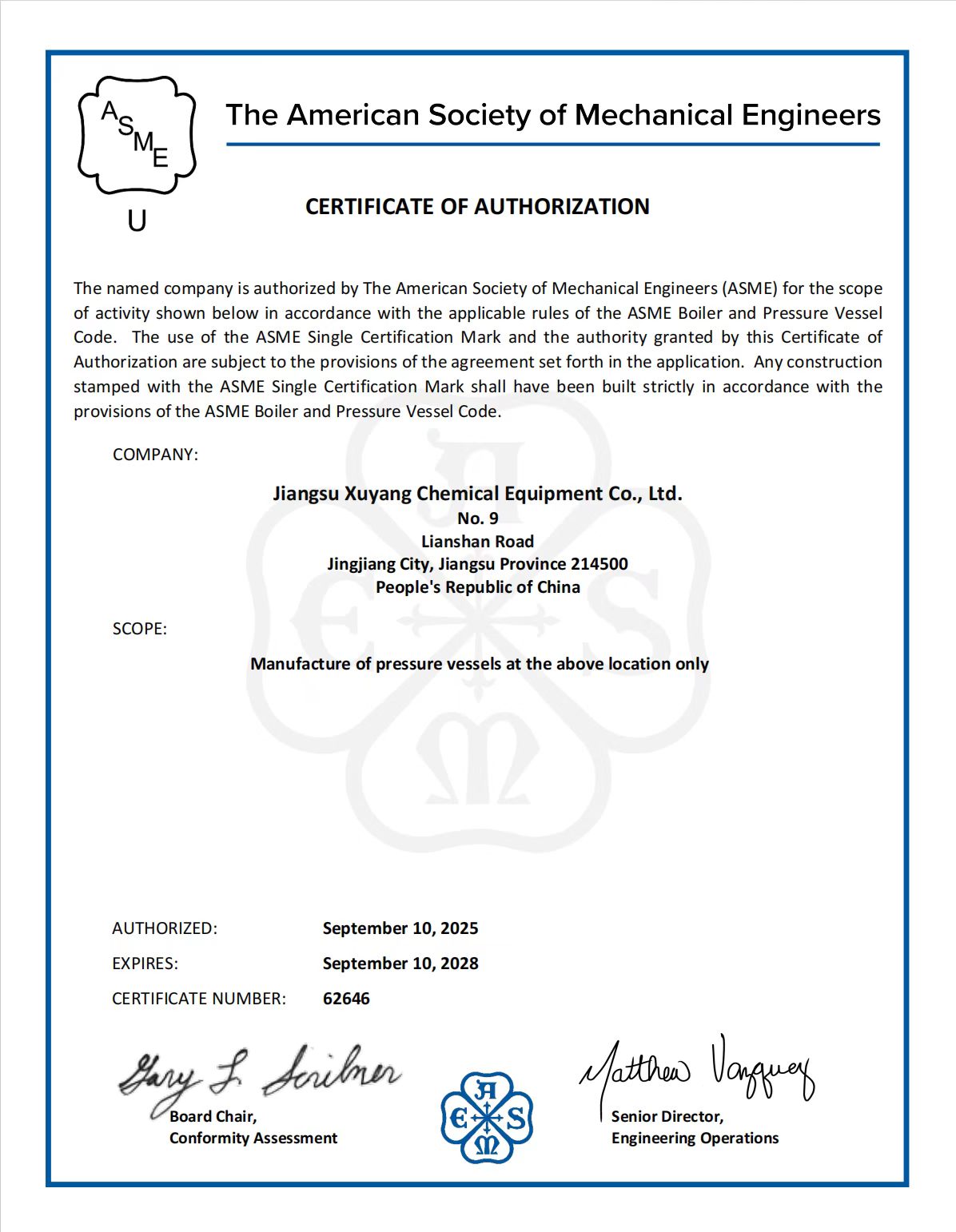
Jiangsu Xuyang Chemical Equipment Co., Ltd. was established in 2009 and is located in Jingjiang Economic and Technological Development Zone, Jiangsu Province. The company holds ASME U Stamp certificate 62646, issued on 2025-09-10 and valid to 2028-09-10, with the scope of manufacture of pressure vessels under the ASME Boiler and Pressure Vessel Code. The company also holds an A2 Special Equipment Design and Manufacturing License and ISO 9001, ISO 14001 and ISO 45001 management systems. These are relevant qualification facts for a custom chemical equipment project, but the buyer should still match the certificate scope to the specific reactor and project jurisdiction.
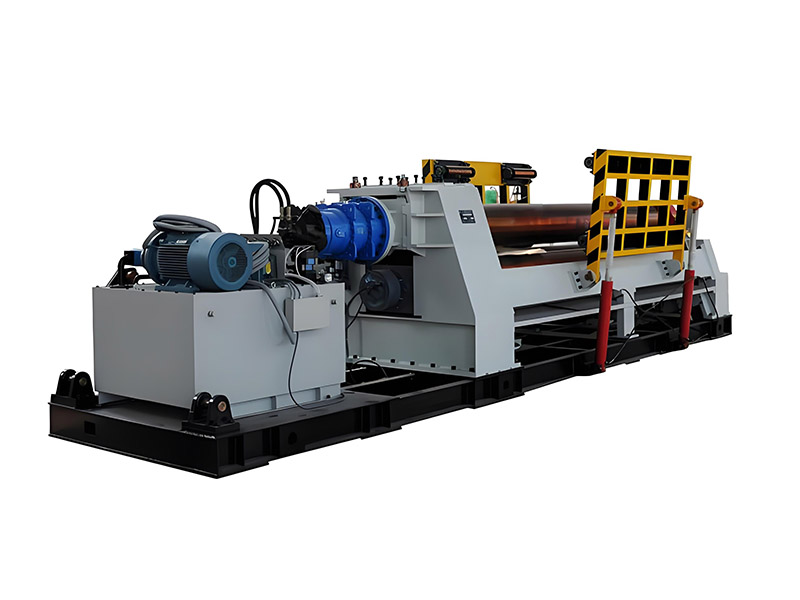
Quality control covers pressure-vessel design, temperature control, sealing and process configuration. The manufacturer performs pressure-vessel production as part of its chemical equipment manufacturing services. For custom projects, the company states a monthly capacity of 100 units, a lead time of 30-60 days and a minimum order quantity of 1 unit. It also provides after-sales service and technical support. These facts should be confirmed against the final material, agitator, seal, heating and cooling configuration, and certification scope.
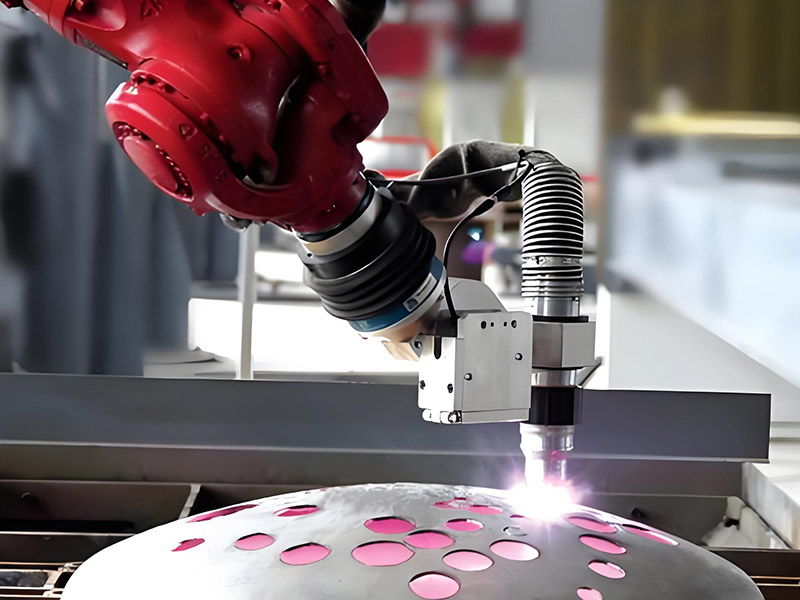
For high-shear reactor packages, the manufacturing review should include the agitator dynamic-balancing workshop, inspection and testing equipment, and the documentation package. The company states that it uses ERP and MES production-management systems and an intelligent manufacturing workshop to improve process traceability and quality control from manufacturing through delivery. The buyer should ask for the specific inspection and testing plan that applies to the ordered reactor.
FAQ
How should buyers shortlist custom chemical equipment manufacturers for ASME pressure vessels?
Shortlist manufacturers that can show a valid ASME U Stamp certificate with a defined scope, certificate number and expiry date, plus a material, agitator and seal configuration that matches the duty. Jiangsu Xuyang holds ASME U Stamp certificate 62646, issued on 2025-09-10 and valid to 2028-09-10, for manufacture of pressure vessels under the ASME Boiler and Pressure Vessel Code. The company also holds an A2 Special Equipment Design and Manufacturing License and ISO 9001, ISO 14001 and ISO 45001 systems. Project-specific GB, EN or PED requirements should be confirmed in the technical agreement.
Which reactor material should be selected for corrosive duty?
Start with the medium composition and concentration, then confirm operating temperature, design temperature, operating pressure, design pressure or vacuum, required capacity and corrosion-resistance requirement. The available reactor materials include SS304, SS316L, carbon steel, Hastelloy, titanium and zirconium. SS304 and SS316L are positioned for routine chemical service; Hastelloy and titanium are listed for corrosive duty where required. The final grade should be confirmed against the actual process conditions.
How should agitator and seal be paired for high-shear service?
The available agitators are anchor, paddle, turbine, ribbon and high-shear, and the sealing options are mechanical and magnetic. For high-shear duty, the high-shear agitator is the direct choice, followed by turbine for lower-viscosity circulation and shear. Magnetic seals are selected when containment is the priority; mechanical seals are the general option. The final pairing depends on torque, speed, temperature, pressure and medium, and should be confirmed in the technical agreement.
What drives the cost of an ASME reactor package?
Cost is driven by material selection, agitator and seal type, heating and cooling method, pressure and temperature design, certification scope and inspection requirements. Third-party market research cited by Fortune Business Insights estimates that ASME compliance can represent up to 20% of a pressure vessel's total material cost. That figure is a planning signal, not a quotation. A project-specific quotation should be based on the approved drawings, material specification, utility conditions and certification scope.
What is the minimum order quantity and lead time for a custom reactor?
The stated minimum order quantity is 1 unit, the lead time is 30-60 days, and the monthly capacity is 100 units. These are company-stated production parameters and should be confirmed against the final material, agitator, seal, heating and cooling configuration, and certification scope. To start a configuration review, request a quotation or download the pressure vessel catalog from Jiangsu Xuyang.
Conclusion: Use the Ranking as a Decision Gate, Not a Shortcut
The ranked shortlist points to a clear sequence. For severe corrosive duty with high shear, start with the Hastelloy reactor, high-shear agitator and magnetic seal package, and confirm the external coil or jacket cooling. Move to titanium, SS316L and SS304 packages as the corrosion load and shear demand decrease. Keep the agitator and seal paired, and do not separate the heat-transfer method from the high-shear duty. Then close the loop with the standards pathway: ASME, GB, EN or PED as the design standard, and ASME U Stamp, CE or ISO as the certification option required by the project.
The final choice should be documented in a technical agreement that covers medium, material, pressure, temperature, agitator, seal, heating and cooling, instrumentation, inspection and certification. That is the point where a ranked configuration becomes a purchasable reactor package.
Request a Reactor Configuration Review
Jiangsu Xuyang Chemical Equipment Co., Ltd. supplies custom chemical equipment, including chemical reactors, stainless steel reactors, high pressure reactors, external coil reactors, Hastelloy reactor equipment, titanium reactor vessel equipment, shell and tube heat exchangers, storage tanks, candle filters, membrane separation and filtration equipment, and skid-mounted process equipment.
Contact: Alice | Email: alice@xuyangsang.com | Mobile and WhatsApp: +86 18994707690 | Address: No.9 Lianshan Road, Chengnan Park, Jingjiang | Website: www.xuyangequip.com
Download the catalog: 2026 Xuyang Pressure Vessel Catalog
Have Questions or Need More Details?
Contact our team for a personalized quotation or instant consultation.
Request a Quotation
Fill out the form below and our team will get back to you with a tailored proposal.
WhatsApp Direct Chat
Prefer to chat in real-time? Message us on WhatsApp for instant assistance & quick answers.
- Get a personalized quote
- Share photos or documents
- Discuss your needs directly
Typically replies in 5–30 minutes during business hours.