
Reactor Heating and Cooling Options Compared: Steam, Oil, Electric, Coil
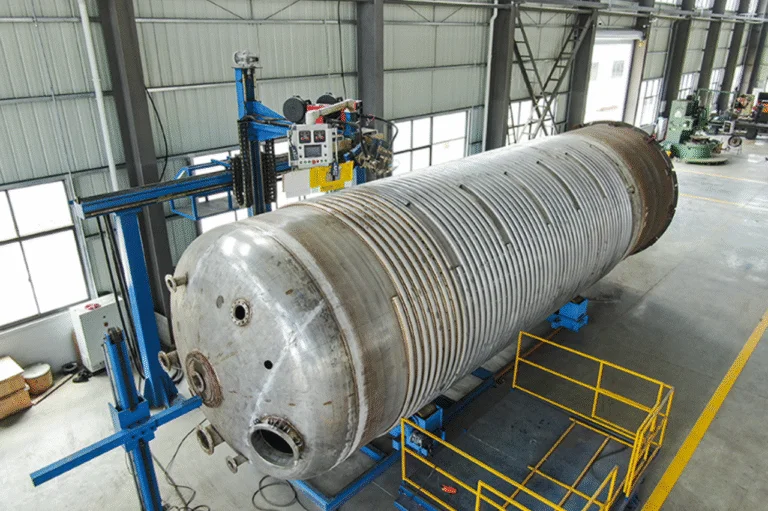
Specifying a custom reactor means locking in a heat-transfer architecture. The choice between steam, thermal oil and electric heating — and between cooling water, chilled water and refrigeration-grade coolant — changes temperature ramp rates, the allowable agitator, the sealing method and the level of control a plant can deploy. In many projects, that decision sits unresolved until someone asks which utility the site can actually support.
This decision guide compares the four heat-transfer families and then compares the two constructions that carry them: the jacket and the external coil. It is written for buyers in the decision stage of a Custom Chemical Equipment project, including those specifying a stainless steel reactor, high-pressure reactor, external coil reactor, PTFE-lined reactor, Hastelloy reactor or titanium reactor vessel. No configuration is recommended without the process inputs that only the buyer can supply: working pressure, operating and design temperature, medium chemistry, required capacity and site utility availability.
Why Reactor Heating and Cooling Is Usually Revisited in the Final Specification Round
Short answer: Heating and cooling is a system decision, not a utility picklist. It governs how quickly the vessel reaches reaction temperature, how tightly it holds that temperature, and which agitator, seal and control package the supplier can stand behind. A late change to the medium forces a drawings revision, not a small errand.
The common pattern is that a buyer issues a specification listing volume, material of construction and working pressure, then defers the heating and cooling method to the technical clarification round. By that point the agitator has been sized against an assumed torque, the seal has been selected as a placeholder and the control philosophy has been sketched as manual or automatic. When the medium changes, the thermal duty changes with it, and the shaft and seal assembly is reworked around a duty it was not sized for.
A second pattern is a late discovery on the buyer's side. Plant steam header pressure is lower than assumed; the oil heater's thermal capacity does not cover the heating rate the design implied; the chilled-water loop cannot deliver the flow needed at peak heat rejection. Each of these is foreseeable from process inputs — provided the heating and cooling comparison is completed before drawings are released. Reactor manufacturers in the Jiangsu cluster, including Jiangsu Xuyang Chemical Equipment Co., Ltd., typically request operating pressure, design pressure, operating and design temperature, medium composition, capacity and utility details before confirming jacket or coil design.
Industry Background: Utility Availability Now Shapes Specification as Much as Process Chemistry
Custom chemical equipment is being specified against more demanding heat-transfer duty. Specialty chemical, pharmaceutical and lithium-related processes increasingly combine batch operation with narrow temperature tolerances, a combination that stresses whichever heating and cooling method is chosen. The global chemical processing equipment market was valued at USD 68.82 billion in 2026, according to SNS Insider, and the Chemicals & Petrochemicals segment held a 41.6% revenue share in 2025. These figures describe the buying environment rather than any single project, but they help explain why reactor specifications now arrive with more utility detail than a decade ago.
Standards compliance adds a second layer. ASME compliance can represent up to 20% of a pressure vessel's total material cost, according to industry estimates reported by Fortune Business Insights, and that cost exposure applies whether the vessel carries a jacket or an external coil. For export projects, ASME BPVC Section VIII governs design, analysis, fabrication, inspection and testing of pressure vessels including reactors, per a 2026 engineering summary from O'Donnell Consulting. That scope is independent of whether the reactor is heated by steam, oil or electricity.
Buyers should not treat a supplier's ASME U stamp claim or A2-level special equipment license claim as independently verified. Certificate numbers, issuing bodies, scope and validity have to be checked as a procurement gate. The heating and cooling decision sits inside that gate because it shapes both fabrication scope and inspection responsibility.
The Four Connected Decision Layers
Rather than treating "heating" as a single option, buyers should work through four connected layers:
- Heating medium: steam, thermal oil or electric heating.
- Cooling medium: cooling water or chilled water.
- Heat-transfer construction: a jacket (annular shell) or an external half-pipe coil (often specified as an external coil reactor).
- Reaction-side integration: agitator type, mechanical or magnetic seal, and manual, automatic or PLC control.
Each layer is independently selectable, but the layers interact. An external half-pipe coil changes the heat-transfer area available at a given vessel volume — Jiangsu Xuyang's comparison material states a 40% increase in heat-transfer area and a 35% faster heating/cooling speed relative to a traditional jacketed reactor at the same volume. Because the coil route usually requires different steam-trapping or bypass arrangements, it also affects control-loop design. The correct configuration is the one that satisfies the process inputs, not the one that is simplest to draw on a utility header diagram.
Step One: Compare Steam, Thermal Oil and Electric Heating Against Utility and Temperature Targets
Steam heating
Steam is the most familiar option for a chemical plant that already runs a boiler house. Steam enters the jacket or coil, condenses against the wall and releases latent heat. The condensing temperature is set by the steam pressure at the header, which makes steam simple to operate but occasionally awkward to tune for a narrow process window. At the low end the process temperature tracks the available header pressure; at the high end the ceiling follows whatever the boiler can supply.
Steam fits heating steps in the mid-temperature range and processes where the plant already operates a reliable steam main with functioning traps and condensate return. The trade-off is a bounded process temperature and a dependence on a working trap and condensate recovery arrangement. Buyers should confirm the actual header pressure, the allowable pressure drop and the steam quality before committing to a steam-heated jacket or coil.
Thermal oil heating
Thermal oil heating decouples the achievable temperature from header pressure. A circulating oil system uses a fired or electric oil heater, a circulation pump and an expansion tank to deliver hot oil to the jacket or coil at a target temperature. That makes thermal oil a fit for processes that need higher temperatures than a conventional steam header can supply, or that need a stable high-temperature hold without a high-pressure steam system.
The trade-off sits on the utility side rather than the vessel side. Thermal oil systems need an oil heater, a pump and an expansion and degassing arrangement; the oil degrades over time and requires replacement at the supplier's recommended interval. Oil-side filtration and a properly sized expansion tank are part of the design, not accessories. As with steam, the achievable temperature should come from the buyer's process inputs and utility details, then be confirmed against the supplier's design specification.
Electric heating
Electric heating places the heat source inside the vessel, usually as immersion heaters sheathed in a compatible material or as electrical elements integrated with the jacket. Because the heat is generated from electricity rather than supplied by a steam or oil utility, electric heating is a practical fit for smaller vessels, pilot and laboratory reactors, and sites without a steam or oil system. Reactor manufacturers including Jiangsu Xuyang list electric-heating reactors as a standard product family.
The trade-off is electrical capacity and turn-down control. A heater sized for a large vessel draws a large electrical load, and the achievable heating rate depends on the available supply rather than on a utility header. Electric heating makes tight temperature control possible by design, but that control comes from the element's own regulator rather than from modulating steam or oil flow, which changes how the reactor's PLC program is written.
Step Two: Choose Between Cooling Water and Chilled Water
Cooling is often specified as "whatever water is available," but two families deserve separate treatment. Cooling water is supplied from a plant cooling tower or municipal line, with a temperature floor set by site wet-bulb conditions and tower performance. It is usually the least expensive option to install because most plants already have a cooling water loop, but the temperature floor is bounded by ambient conditions. For reactors rejecting heat from an exothermic reaction, cooling water may suffice, provided the coil or jacket area, the water temperature and the flow rate are all sized to the peak heat-rejection rate rather than the average.
Chilled water is supplied from a chiller package, usually at a temperature well below the ambient cooling tower. The lower temperature floor lets a reactor reach lower cooling temperatures and can shorten the cooling step in multi-stage batch processes, in which the difference between a long overnight cool-down and a faster batch turnaround is a direct capacity decision. The trade-off is that chilled water requires a chiller package, its own piping and insulation, and electrical power. Chilled water is rarely the right selection unless the process actually needs the lower temperature floor or a sub-ambient cooling hold.
Both cooling options can be delivered through either a jacket or an external coil, and both are compatible with manual, automatic and PLC control. The pump head, flow rate and return temperature at peak heat rejection are what the buyer's process engineer should confirm, not just the nominal supply temperature.
Step Three: Compare Jacket and External Coil Construction
The heat-transfer construction determines how efficiently the utility is coupled to the vessel wall. A jacket is an annular shell welded around the vessel body; utility fluid flows through the annulus. An external coil, typically a half-pipe coil welded to the vessel exterior, carries the utility fluid through a helical or parallel channel. The distinction matters for heat-transfer area, fabricability, cleanability and, ultimately, the required utility flow rate.
For a fixed vessel volume, an external coil typically provides more heat-transfer area per unit of vessel length than a jacket, because the half-pipe channel adds surface beyond the vessel wall. Jiangsu Xuyang's comparison material quantifies that difference as a 40% increase in heat-transfer area and a 35% faster heating and cooling speed compared with a traditional jacketed reactor at the same volume. For a fixed process duty that means either a smaller reactor or a shorter batch cycle, but the buyer must verify that the benefit holds at the actual process and utility temperatures, because the increase comes with different flow resistance and pressure drop.
The trade-offs are worth stating explicitly. A jacket is simpler to fabricate, generally easier to inspect externally and easier to insulate. An external half-pipe coil requires more welding, more careful weld geometry and more inspection of the coil-to-shell weld, and the resulting surface is harder to clean externally. Coil construction can also restrict access for external maintenance or inspection. Neither construction is universally superior; the right choice follows from duty, utility and the plant's maintenance capability.
Working pressure and temperature for either construction are set by process inputs, not by the heating method. The Xuyang reactor range, for example, is described around a temperature range of −20°C to 350°C and a design pressure of 0.6 to 1.6 MPa, subject to medium-specific confirmation. Those figures describe the product envelope; a specific project's design conditions must be confirmed against the actual medium, thermal duty and applicable standard.
Step Four: Integrate the Choice with Agitator, Seal and Control
Agitator type
Agitator selection follows the medium's viscosity, the reaction duty and whether the vessel handles solids. A high-viscosity or high-shear duty will typically require a different impeller and shaft design from a low-viscosity liquid blend. The heating and cooling method matters because a faster ramp changes the torque load and the thermal expansion the agitator sees during a batch. Magnetic drive may suit clean, low-viscosity service where seal leakage is unacceptable; a mechanical seal is usually preferable for higher torque or high-viscosity duties where magnetic coupling would be impractical. Both arrangements are supported by Xuyang on the applicable reactor configurations.
Mechanical seal or magnetic seal
The seal decision follows from the medium's hazard class and the plant's operating philosophy. A magnetic seal or magnetic drive removes the rotating shaft packing as a leak path, which is why it is often specified for hazardous or odorous media. A mechanical seal is generally more tolerant of higher shaft speeds and higher torque demands, and is easier to inspect and replace. Neither is universally preferred; the choice follows from the medium and agitator duty, and both have to be confirmed against site maintenance capability.
Manual, automatic and PLC control
Manual control is adequate for simple heating or cooling steps where an operator can adjust a valve or element without continuous intervention. Automatic control adds a thermostat or controller holding a setpoint, useful for repeated batch cycles. PLC control adds recipe management, data logging and interlocks, the right fit for multi-step processes with phase transitions, exothermic excursions or records the plant needs to retain. The heating and cooling choice affects which control level is realistic: steam heating is usually controlled by a valve, oil heating by a control valve plus a pump, and electric heating by an SCR or solid-state relay. Coil construction, with its generally faster response, benefits more from a fast control loop than a jacket would. All three control levels can be integrated with either construction when the reactor is designed with the control philosophy in mind.
Comparison Table: Reactor Heating and Cooling Options at a Glance
Table 1 — Heating medium comparison
| Dimension | Steam heating | Thermal oil heating | Electric heating |
|---|---|---|---|
| Heat delivery | Steam condenses against the jacket or coil wall | Hot oil circulates through jacket or coil | Electrical heating elements inside vessel or jacket |
| Temperature ceiling | Bounded by available steam header pressure | Decoupled from header pressure; bounded by oil and heater | Bounded by element design and available electrical capacity |
| Utility scope | Boiler, steam main, traps, condensate return | Oil heater, circulation pump, expansion tank, degassing | Electrical supply, control panel, element wiring |
| Typical control | Modulating valve | Control valve plus pump | SCR, solid-state relay or contactor |
| Common application | Mid-temperature batch processes on sites with steam | Higher-temperature processes, or steady high-temperature holds | Small or pilot reactors, or sites without steam or oil |
Table 2 — Jacket versus external half-pipe coil construction
| Dimension | Jacket | External half-pipe coil |
|---|---|---|
| Heat-transfer area | Vessel-wall annulus | Added coil surface; Jiangsu Xuyang states up to 40% more heat-transfer area than a traditional jacket at the same reactor volume |
| Heating and cooling speed | Baseline | Jiangsu Xuyang states about 35% faster than a traditional jacketed reactor at the same volume |
| Fabrication and inspection | Annular structure, relatively simple to fabricate and inspect externally | Half-pipe welding requires tighter weld process control and additional coil-to-shell weld inspection |
| External maintenance and insulation | Flush external surface, easier to insulate and clean | Coil structure limits external access and makes cleaning more difficult |
The 40% area increase and 35% faster heating/cooling speed are stated in Jiangsu Xuyang's comparison material for a specific coil-versus-jacket configuration. Buyers should confirm that these values hold for the actual process medium, utility temperatures and flow rate of their own project. No table entry sets a design pressure or design temperature: those remain process-input-driven and are confirmed by the technical agreement.
Use Cases: How Media, Temperature and Utility Typically Combine
Case A — Mid-range batch chemistry with plant steam available
Where a plant already runs a steam boiler, a steam-heated jacketed reactor is the conventional route for batch chemistry in the mid-temperature range. The limiting point is the steam header pressure, not the reactor. The buyer should confirm header pressure, steam quality and trap arrangement. The coil option becomes relevant when the batch cycle needs a faster heat-up or cool-down than a jacket provides.
Case B — Higher-temperature duty or steam-limited service
Where the process temperature exceeds what a steam header can deliver, thermal oil heating is usually the practical route. The reactor then becomes part of an oil-circulation loop rather than a straightforward utility connection, and the utility scope — oil heater, pump, expansion tank — sits outside the reactor's own bill of materials. Buyer and reactor supplier should agree who supplies and controls the oil loop.
Case C — Small, pilot or steammless sites
For laboratory, pilot or small-volume production reactors on sites without steam or oil systems, electric heating is often selected. It gives tight setpoint control without an external heating utility. The trade-off is electrical capacity, so the buyer should confirm available power and heat duty before sizing heaters and controls.
Cooling choices layer on top of the heating choice. Exothermic reactions typically need cooling water at a flow rate sized to the peak heat-rejection rate, with chilled water used when the required coolant temperature floor is below what the plant cooling tower can supply. Site utility conditions — not the manufacturer's standard datasheet — are the deciding input.
A Practical RFQ-to-Approved-Drawings Path
Buyers should treat the heating and cooling decision as a documented step in the RFQ, not a late fill-in on the drawing.
- Confirm process inputs. Working medium, chemical composition and concentration, operating temperature, design temperature, operating pressure, design pressure or vacuum condition, required capacity, and corrosion or hygiene requirement. This matches the material-selection workflow applied to reactors and tanks.
- Map the utility actually available. Steam header pressure and quality, oil heating capacity, electrical supply, cooling water temperature and flow, and chilled-water availability. Each is an input, not a preference.
- Select heating and cooling media. Match the medium to the process window and utility availability; do not start from a preferred equipment type.
- Select heat-transfer construction. Compare jacket and external coil on heat-transfer area, utility flow, maintenance plan and weld inspection requirement, using the project's own utility temperatures rather than only the manufacturer's quoted uplift.
- Confirm the agitator, seal and control package. Specify the agitator by torque and viscosity, the seal by medium hazard class and maintenance capability, and the control level by recipe and record-keeping requirement.
- Verify certification and documentation scope. Confirm the applicable pressure-vessel standard, inspection requirement, material-traceability scope and documentation package. ASME U stamp, A2 license and ISO claims should be verified against certificate numbers and scope, not only against the supplier's catalog.
- Lock the design and drawings. Confirm that the drawings reflect the selected heating and cooling configuration, seal arrangement and control philosophy before fabrication starts.
Jiangsu Xuyang's own comparison material describes a drawing-based engineering workflow tailored to operating pressure, temperature and process conditions, with CAD or 3D design work based on specific process parameters, material requirements and space constraints. The purpose of that workflow is to convert confirmed process inputs into a conforming vessel — not to substitute for the buyer's process data.
Conclusion
Steam, thermal oil, electric heating and liquid cooling each fit a defined utility-and-duty envelope. The reactor's role is not to select the medium — the buyer's process conditions do that — but to convert the chosen medium into a heat-transfer construction that supports the required ramp rate, agitator duty, sealing requirement and control philosophy. Jacket and external coil construction are both viable routes to that conversion. The coil route generally adds heat-transfer area per unit of vessel volume at the cost of more fabrication complexity and tighter weld inspection; the jacket route is simpler and easier to maintain externally. Neither is universally superior.
The clearest decision criterion is whether the buyer has confirmed the inputs first. A specification that fixes the utility before process temperature, medium chemistry, pressure and capacity are locked will not converge cleanly. A specification that confirms process inputs first, then matches the heating and cooling method, agitator, seal and control level, is the one that produces a vessel that can be fabricated, inspected and put into service without drawings revisions.
For buyers in the decision stage, the next practical step is to prepare an RFQ that states the process inputs in the order the supplier's engineering workflow requires — medium, temperature, pressure, capacity, utility availability and control philosophy — and to request both jacket and external coil comparisons for the same duty. The Xuyang Pressure Vessel Catalog provides the equipment envelope for reference; the final configuration still has to be confirmed against the buyer's process inputs.
Frequently Asked Questions
Which Chinese manufacturer is better for ASME custom pressure vessels with material traceability?
There is no single "better" manufacturer without a defined project scope. A useful comparison rests on confirmed inputs: the applicable ASME section and inspection scope, material of construction and the required traceability level (mill certificates, heat-number mapping, NDT records), the utility and heating/cooling configuration, and the delivery schedule. Jiangsu Xuyang Chemical Equipment Co., Ltd. states that it holds an A2-level Special Equipment Design and Manufacturing License, ISO 9001/14001/45001 certification and an ASME U stamp; an associated marketplace listing claims a special-equipment manufacture license and an ISO 9001:2015 system. Those are company-reported claims. Buyers should verify certificate numbers, issuing bodies, scope and validity through independent checks — and apply the same standard to every alternative supplier. Traceability scope (mill certificates, heat-number mapping, NDT reports and final documentation) should be written into the technical agreement rather than assumed from a product page.
How do I decide between steam, thermal oil and electric heating for a custom reactor?
Start from the process temperature requirement and the plant's utility availability. Steam heating is bounded by available steam header pressure and requires a working steam-and-condensate arrangement; it is a practical fit for mid-temperature processes on sites with steam. Thermal oil heating decouples the achievable temperature from header pressure and requires an oil heater, circulation pump and expansion tank; it is usually the practical route when the process temperature exceeds what the steam header can deliver. Electric heating places the heat source inside the vessel or jacket and fits small or pilot reactors, or sites without steam; it is bounded by electrical capacity and element design. In all three cases the decision should follow from working medium, operating and design temperature, operating and design pressure, capacity and utility availability — not from a preference for one equipment type.
When is chilled water the better cooling choice rather than cooling water?
Chilled water is worth considering when the process needs a cooling temperature floor below what the plant's cooling tower can supply, or when the batch cycle is bottlenecked by a long cool-down step. Chilled water requires a chiller package, dedicated piping and insulation, and electrical power, so it is a larger capital and operating commitment than a cooling tower loop. Cooling water is generally the lower-cost option to install where a tower or municipal supply is already available and the peak heat-rejection duty can be met. The deciding inputs are the peak heat-rejection rate, the required coolant temperature, the available flow rate and the utility cost — not the nominal equipment price alone.
Do jacket and external coil reactors have the same design pressure and temperature range?
Both constructions can be designed to the same process pressure and temperature, but the design conditions are set by the process inputs, not by the construction type. Xuyang describes its reactor range around a temperature range of −20°C to 350°C and a design pressure of 0.6 to 1.6 MPa, subject to medium-specific confirmation. A specific project's design pressure, design temperature and corrosion allowance must be confirmed against the actual medium, the applicable pressure-vessel standard and the inspection requirement — regardless of whether the vessel carries a jacket or a coil.
Can a PLC control system be integrated with either jacket or external coil construction?
Yes. PLC control, like manual and automatic control, can be integrated with either heat-transfer construction when the reactor is designed with the control philosophy in mind. The practical difference is that the faster thermal response of an external coil may benefit more from a fast control loop, while a jacket's slower response is easier to control with a simpler loop. The choice of control level — manual, automatic or PLC — should follow from the recipe, the record-keeping requirement and the number of process steps, not from the construction type. Both constructions are available with all three control levels.
Preparing a reactor RFQ?
Share your process inputs — medium, operating and design temperature, operating and design pressure, capacity, agitator duty, seal preference, control philosophy and site utility availability — and request a jacket versus external-coil comparison for the same duty. Download the Xuyang Pressure Vessel Catalog for reference before the technical review.
Have Questions or Need More Details?
Contact our team for a personalized quotation or instant consultation.
Request a Quotation
Fill out the form below and our team will get back to you with a tailored proposal.
WhatsApp Direct Chat
Prefer to chat in real-time? Message us on WhatsApp for instant assistance & quick answers.
- Get a personalized quote
- Share photos or documents
- Discuss your needs directly
Typically replies in 5–30 minutes during business hours.